Left ventricle segmentation


This notebook demonstrates how to perform left ventricle segmentation in echocardiograms using two different models within the zea framework. We apply both models on the CAMUS dataset for demonstration.
1. Augmented CAMUS Segmentation Model


nnU-Net based model trained on the augmented CAMUS dataset.
Segments both the left ventricle and myocardium (2 labels).
State-of-the-art for left ventricle segmentation on CAMUS.
2. EchoNetDynamic

Trained on the EchoNet-Dynamic dataset.
Segments the left ventricle in echocardiograms.
Note that this model is only currently supported with the TensorFlow or JAX backend. See the model documentation for more details.
‼️ Important: This notebook is optimized for GPU/TPU. Code execution on a CPU may be very slow.
If you are running in Colab, please enable a hardware accelerator via:
Runtime → Change runtime type → Hardware accelerator → GPU/TPU 🚀.
[1]:
%%capture
%pip install zea
%pip install onnxruntime # needed for the Augmented CAMUS Segmentation Model
[2]:
import os

os.environ["KERAS_BACKEND"] = "tensorflow"

from zea import init_device, Dataloader
import matplotlib.pyplot as plt
from keras import ops
from zea.visualize import plot_shape_from_mask
from zea.func import translate
from zea.visualize import plot_image_grid, set_mpl_style

init_device(verbose=False)
set_mpl_style()
zea: Using backend 'tensorflow'
Load CAMUS Validation Data
We load a batch of images from the CAMUS validation set. This batch will be used as input for both segmentation models.
[3]:
n_imgs = 16
INFERENCE_SIZE = 256  # Used for both models
val_dataset = Dataloader(
    "hf://zeahub/camus-sample/val",
    key="data/image_sc",
    batch_size=n_imgs,
    shuffle=True,
    image_range=[-45, 0],
    clip_image_range=True,
    normalization_range=[-1, 1],
    image_size=(INFERENCE_SIZE, INFERENCE_SIZE),
    resize_type="resize",
    seed=42,
)

batch = next(iter(val_dataset))
rgb_batch = ops.concatenate([batch, batch, batch], axis=-1)  # For EchoNetDynamic
zea: Searching /root/.cache/zea/huggingface/datasets/datasets--zeahub--camus-sample/snapshots/617cf91a1267b5ffbcfafe9bebf0813c7cee8493/val for ['.hdf5', '.h5'] files...
zea: Dataset was validated on April 09, 2026
zea: Remove /root/.cache/zea/huggingface/datasets/datasets--zeahub--camus-sample/snapshots/617cf91a1267b5ffbcfafe9bebf0813c7cee8493/val/validated.flag if you want to redo validation.
zea: Loading cached result for _find_h5_file_shapes.
Inference with Augmented CAMUS Model
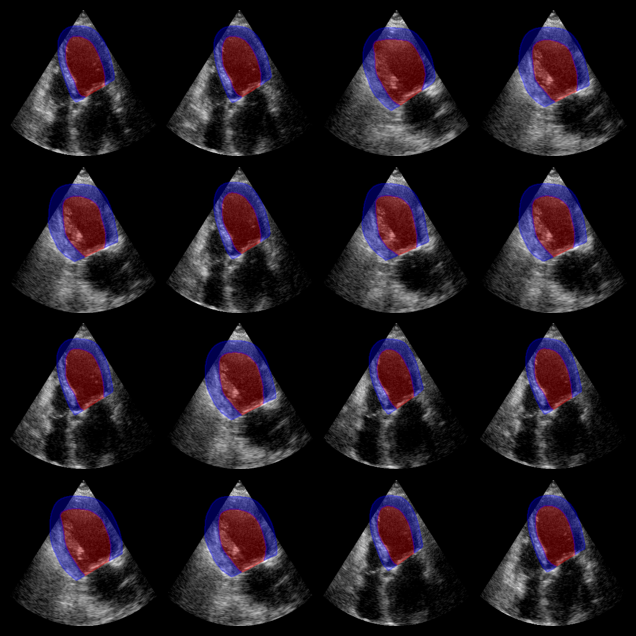
First we test the Augmented CAMUS nnU-Net model, which segments both the left ventricle and myocardium (2 labels). The model expects input in NCHW format (batch, channels, height, width).
[4]:
from zea.models.lv_segmentation import AugmentedCamusSeg
import numpy as np

# Load model and weights
model_camus = AugmentedCamusSeg.from_preset("augmented_camus_seg")

# Prepare input for ONNX (NCHW: batch, channels, height, width)
batch_np = ops.convert_to_numpy(batch)
onnx_input = np.transpose(batch_np, (0, 3, 1, 2))

# Inference
outputs_camus = model_camus.call(onnx_input)
outputs_camus = np.array(outputs_camus)
# Predicted class = class with the highest score for each pixel
masks_camus = np.argmax(outputs_camus, axis=1)  # shape: (batch, H, W)

# Visualization: show both LV (label 1) and myocardium (label 2)
fig, _ = plot_image_grid(batch_np, vmin=-1, vmax=1)
axes = fig.axes[:n_imgs]
for ax, mask in zip(axes, masks_camus):
    # LV: label 1, Myocardium: label 2
    plot_shape_from_mask(ax, mask == 1, color="red", alpha=0.3)
    plot_shape_from_mask(ax, mask == 2, color="blue", alpha=0.3)

plt.savefig("augmented_camus_seg_output.png", bbox_inches="tight", dpi=100)
plt.close(fig)
Augmented CAMUS segmentation results:
Red: left ventricle mask. Blue: myocardium mask.
Inference with EchoNetDynamic Model
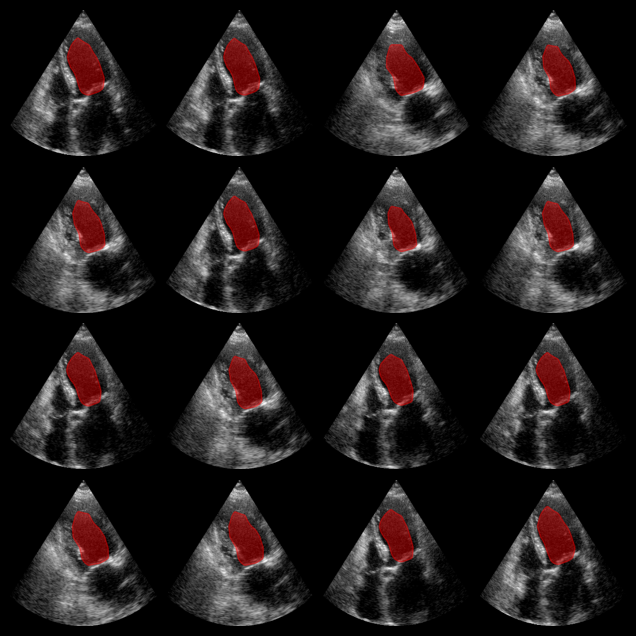
Now we proceed with the second segmentation model, EchoNetDynamic model, which expects RGB input images. The model was trained on the EchoNet-Dynamic dataset, but here we apply it to CAMUS data for demonstration.
[5]:
from zea.models.echonet import EchoNetDynamic

# Load model
model_echonet = EchoNetDynamic.from_preset("echonet-dynamic")

# Inference (expects RGB input)
masks_echonet = model_echonet(rgb_batch)
masks_echonet = ops.squeeze(masks_echonet, axis=-1)
masks_echonet = ops.convert_to_numpy(masks_echonet)

# Visualization
batch_vis = translate(rgb_batch, [-1, 1], [0, 1])
fig, _ = plot_image_grid(batch_vis, vmin=0, vmax=1)
axes = fig.axes[:n_imgs]
for ax, mask in zip(axes, masks_echonet):
    plot_shape_from_mask(ax, mask, color="red", alpha=0.4)

plt.savefig("echonet_output.png", bbox_inches="tight", dpi=100)
plt.close(fig)
EchoNetDynamic segmentation results:
The red overlay shows the predicted left ventricle mask for each image.